Few places on Earth combine raw geological power and untouched marine ecosystems quite like the Banda Sea. Located in the heart of Indonesia’s tectonic “Ring of Fire,” this remote region offers a dramatic underwater landscape shaped by volcanic eruptions, shifting plates, and deep ocean trenches. For divers seeking something beyond coral gardens and reef slopes, Banda Sea diving offers towering lava walls, black-sand slopes, and thriving ecosystems born of fire and magma.
This is not just another tropical dive destination. It’s a living geological story unfolding beneath the surface.
The Power of Gunung Api
At the center of this volcanic narrative stands Gunung Api, an active stratovolcano rising sharply from the sea near the Banda Islands. Above water, its perfectly conical shape dominates the skyline. Below the surface, it transforms into one of the most extraordinary dive environments in Indonesia.
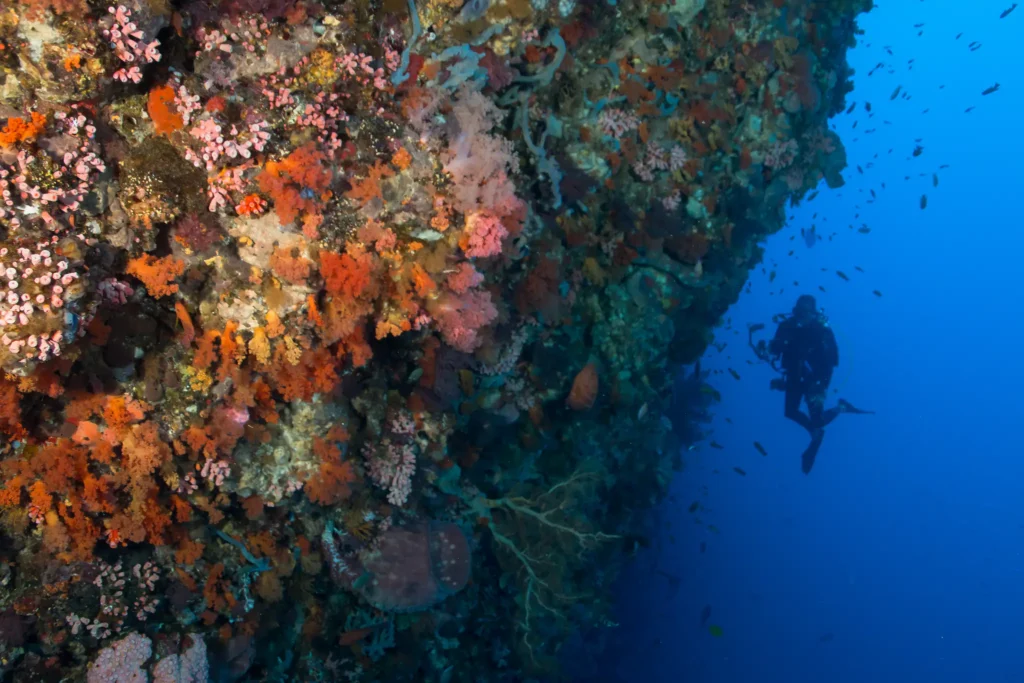
Gunung Api’s last major eruption in 1988 reshaped the surrounding reefs entirely. Lava flows poured into the sea, destroying coral structures, but what followed is even more fascinating. Within a few years, new coral growth began colonizing the hardened lava rock. Today, divers descend along vibrant reef walls bursting with life, all built upon what was once molten rock.
This is where geology meets regeneration. On a banda sea liveaboard, divers can witness how destruction becomes biodiversity in real time.
Also read Why Raja Ampat Is Famous Through Diving Liveaboard Expeditions Beyond the Usual Spots
Volcanic Walls That Drop Into the Abyss
The Banda Sea is one of Indonesia’s deepest bodies of water, with the Banda Trench plunging more than 7,000 meters. That depth shapes everything. Many dive sites here are dramatic vertical walls formed by volcanic uplift and tectonic shifts.
These walls are not gentle slopes; they drop steeply into the deep blue, creating a sense of true exposure. Nutrient-rich currents sweep along these formations, attracting schooling fish, reef sharks, and pelagic hunters. The depth and structure also create ideal conditions for large marine life to patrol the edges.
Unlike heavily trafficked dive regions, Banda Sea diving feels wild and expansive. You’re not simply exploring a reef; you’re diving along the edge of tectonic history.
Lava-Formed Reef Systems
One of the most unique features of the Banda region is its lava-formed reef systems. When volcanic rock cools underwater, it creates textured, porous surfaces that coral larvae readily attach to. Over time, these once-barren rock faces transform into thriving reef habitats.
Gunung Api is the prime example, but it’s not alone. Several Banda islands were formed through volcanic activity, and their underwater topography reflects that origin. Instead of flat reef tables, you’ll find ridges, pinnacles, and jagged formations sculpted by eruptions and seismic movement.
These unusual structures create microhabitats for reef fish, macro species, and larger predators. Divers often notice how dense and concentrated marine life appears around these formations. The combination of nutrient upwellings and vertical terrain supports biodiversity.
A well-planned diving cruise through this region allows access to multiple volcanic formations, each offering a slightly different ecosystem shaped by its geological past.
How Tectonics Shape Marine Biodiversity
The Banda Sea sits at the collision point of the Indo-Australian and Eurasian tectonic plates. This constant geological movement influences everything underwater.
First, tectonic activity creates dramatic changes in depth. Deep trenches lie close to shallow reefs, allowing cold, nutrient-rich water to rise toward the surface. These upwellings feed plankton blooms, which attract baitfish, which in turn attract larger predators. It’s a full ecological chain reaction driven by geology.
Second, isolation plays a major role. The Banda Islands are remote and seasonally accessible, meaning reefs experience less pressure from tourism and coastal development. Combined with the structural complexity of volcanic terrain, this creates conditions for highly resilient reef systems.
For divers, this translates into dense fish schools, healthy coral growth, and frequent encounters with pelagic species. When experienced through a curated itinerary, such as a Wallacea dive cruise, the region reveals how Earth’s internal forces directly influence marine abundance.
A Destination for the Curious Diver
Banda Sea diving is not defined by luxury or convenience. It is defined by exploration. The crossings are longer, the conditions can be dynamic, and the sites are remote. But for those who seek more than postcard reefs, the reward is immense.
You are diving along fresh lava fields reclaimed by coral. Drifting past vertical walls formed by plate collisions. You are swimming above some of the deepest waters in Indonesia.
This is diving shaped by fire, pressure, and time.
And in a world where many reefs face increasing stress, the Banda Sea stands as a reminder of nature’s ability to rebuild and thrive even in the wake of an eruption.
For divers who want to understand not just what they see underwater but why it exists, the volcanic heart of the Banda Sea offers an unforgettable journey into Earth’s living geology.